
Registration

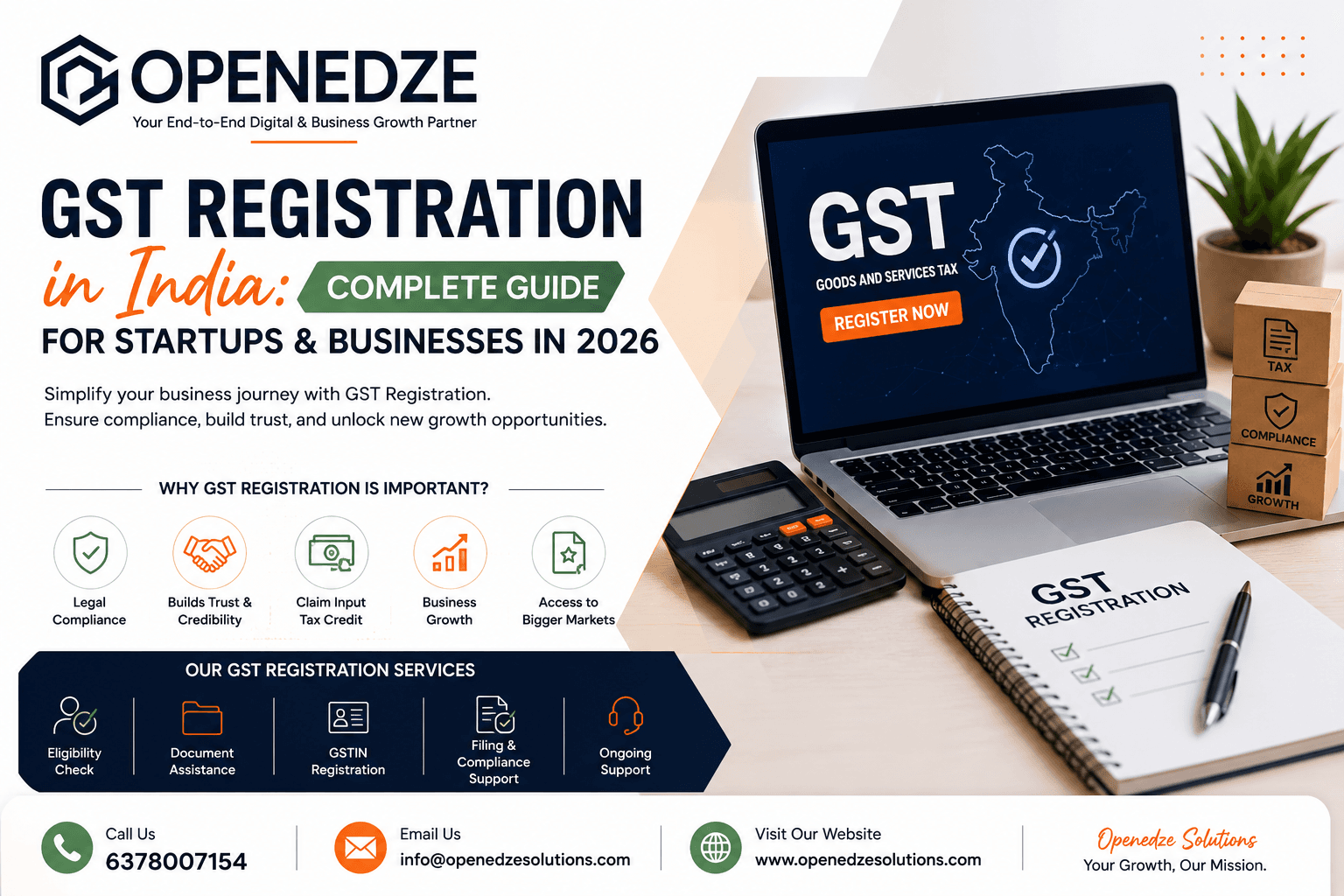
GST Registration in India: Complete Guide for Startups & Businesses in 2026

A comprehensive guide to GST registration process, requirements, compliance deadlines, and how to register your business for GST in 2026.

Openedze Strategy Desk20 May 202612 min read
Professional tax consultant reviewing GST registration documents and digital tax filing
Tax and compliance professional documentation

GST registration is one of the most critical compliance requirements for Indian businesses. Since the Goods and Services Tax (GST) launch in July 2017, any business crossing the turnover threshold must register with the GST authorities.

In 2026, GST compliance remains mandatory for most businesses, and the process has become simpler through the GSTIN portal. However, many entrepreneurs still struggle with eligibility criteria, timeline, documentation, and post-registration compliance.

This guide provides everything you need to know about GST registration, from eligibility to filing your first returns. We also explain how Openedze Solutions helps businesses register quickly and stay compliant.

Key Insights

GST registration is mandatory if your annual turnover exceeds ₹40 lakhs (or ₹20 lakhs for special category states) or if you engage in interstate trade.

The GST registration process is free and takes 3-5 working days if all documents are correct.

After GST registration, you must file GST returns regularly (GSTR-1, GSTR-3B, GSTR-9) based on your business type.

GST Input Tax Credit (ITC) is one of the biggest benefits of GST registration, allowing you to claim back taxes paid on purchases.

What is GST and Why Does It Matter?

Goods and Services Tax (GST) is India's unified indirect tax that replaced multiple taxes like sales tax, VAT, excise duty, and service tax. It is a consumption-based tax collected at every stage of the supply chain.

When you register for GST, your business becomes part of the formal tax system. This gives you legal recognition, allows you to collect GST from customers, and enables you to claim Input Tax Credit (ITC) on your purchases.

For customers and businesses, GST registration signals legitimacy, compliance, and transparency. Many large clients and B2B partners prefer working with GST-registered vendors because it ensures proper documentation and tax compliance.

GST is a single, unified tax system across all states in India
GST replaced multiple taxes (sales tax, VAT, service tax, excise)
GST registration is required for most businesses above a certain turnover threshold
GST provides legitimacy and access to B2B business opportunities
GST registration enables Input Tax Credit (ITC) claims
Strategic note: Key Insight: GST is not a new tax on top of existing taxes. It is a replacement for multiple taxes. Proper GST registration and compliance help you reduce your overall tax burden.

Who Needs GST Registration? Eligibility Criteria

GST registration is mandatory for certain businesses and optional for others. The main eligibility criterion is your annual turnover. However, there are exceptions and special cases.

If your turnover exceeds the threshold, you must register for GST even if you do not want to. The GST authorities treat non-registration as a compliance violation and can impose penalties.

Mandatory: Turnover > ₹40 lakhs per financial year (general states)
Mandatory: Turnover > ₹20 lakhs per financial year (Arunachal Pradesh, Manipur, Meghalaya, Mizoram, Nagaland, Sikkim, Telangana, Tripura, Uttarakhand)
Mandatory: All interstate traders, regardless of turnover
Mandatory: All e-commerce operators
Mandatory: Importers and exporters
Optional: Service providers with turnover < ₹20 lakhs (can voluntarily register)
Not eligible: Governments, certain educational institutions, and some non-profit organizations
Strategic note: Business Opportunity: Even if your turnover is below the threshold, voluntary GST registration can be beneficial. Many B2B clients only purchase from GST-registered vendors, and ITC benefits often justify the registration.

Key Benefits of GST Registration

GST registration is not just a compliance requirement. It provides real business and financial benefits that can reduce your tax burden and improve your market position.

Understanding these benefits helps you make the right decision about when and how to register. For many businesses, the advantages far outweigh the compliance burden.

Input Tax Credit (ITC): Claim back GST paid on purchases, reducing your overall tax liability
B2B Market Access: GST-registered vendors get preference from corporate and institutional buyers
Cross-border Trading: Register once in India and sell across all states without state-level taxes
Legitimacy & Trust: GST registration increases customer confidence and brand credibility
Invoice Credibility: GST invoices are legally recognized and required for B2B transactions
Accurate Record-Keeping: GST portal automates your tax records and filing
Compliance Certainty: Regular GST filing creates a compliance trail that protects you from tax disputes
Strategic note: Strategic Insight: The biggest financial benefit is Input Tax Credit (ITC). If you purchase ₹10 lakhs of goods with 18% GST, you can claim ₹1.8 lakhs as credit. This can significantly reduce your tax liability.

Step-by-Step GST Registration Process in 2026

The GST registration process is now completely online through the GSTIN portal. It has been streamlined to be faster and more transparent. Here is the exact process to register your business for GST.

The process typically takes 3-5 working days if all your documents are in order. In some cases, additional verification may be required, which could extend the timeline.

Step 1: Gather all required documents (PAN, Aadhaar, address proof, business details)
Step 2: Create login on GST portal (www.gst.gov.in) using your PAN
Step 3: Fill Application Part A (basic business information)
Step 4: Fill Application Part B (detailed business information, promoter details, annual turnover)
Step 5: Upload all required documents in digital format (PDF/JPG)
Step 6: Review and submit the application
Step 7: GSTIN is auto-generated (pre-registration stage) within minutes
Step 8: Await verification from local GST office (3-5 days)
Step 9: GST registration certificate issued
Step 10: Download your GST registration certificate and begin filing returns
Strategic note: Pro Tip: Most applications are auto-approved if documents are correctly uploaded. Manual verification is rare unless there are discrepancies or special circumstances.

Complete Checklist: Documents Required for GST Registration

Having all documents ready before you start the GST registration process is essential. Missing or incorrect documents are the main reason applications are delayed or rejected.

The specific documents you need depend on your business structure (sole proprietorship, partnership, private company, etc.). Here is a comprehensive checklist.

PAN (Permanent Account Number) of the business and all partners/directors
Aadhaar number of all directors/partners (OTP verification required)
Proof of business address (electricity bill, rental agreement, property document, or lease deed not older than 3 months)
Proof of residential address for all directors/partners (same as above)
Bank account number and IFSC code
Memorandum of Association (for companies)
Partnership deed (for partnerships)
Details of business premises location (even if it is a home office)
Declaration of beneficial ownership (for all partners/directors holding >25% stake)
Authorization letter (if someone else is filing on your behalf)
Strategic note: Document Clarity: All documents must be in digital format (PDF or JPG, max 5 MB each). Ensure scans are clear and readable; blurry documents can cause rejection or delays.

GST Compliance & Filing Requirements After Registration

GST registration is just the beginning. After you register, you have ongoing compliance requirements. Understanding these helps you stay compliant and avoid penalties.

The main GST compliance obligations include regular return filing, maintaining records, issuing proper invoices, and keeping track of Input Tax Credit.

GSTR-1 (Outward Supplies): File monthly return of goods/services sold (due 11th of next month)
GSTR-2A (ITC Eligibility): Auto-populated from vendor GSTR-1 returns (verify and accept)
GSTR-3B (Summary Return): File monthly summary of sales, purchases, and tax payable (due 20th of next month)
GSTR-9 (Annual Return): File annual return within 31st December of the next financial year
GSTR-9A: Simplified annual return (for eligible businesses)
Invoice Management: Maintain proper GST invoices with all required details
Record Maintenance: Keep all purchase bills, invoices, and transaction records for 6 years
ITC Compliance: Claim Input Tax Credit only on eligible purchases
Strategic note: Compliance Reality: Most GST filings are now pre-populated from your suppliers' returns. Your job is to verify the data, make corrections if needed, and file the return before the deadline.

GST Registration Cost and Fees in 2026

One of the biggest misconceptions about GST registration is that it is expensive. In reality, GST registration itself is completely free. You do not pay any government fees.

However, there are costs you should account for if you hire a professional consultant to help with the process.

GST registration fee from Government: ₹0 (completely free)
Professional consultant charges: ₹2,000 - ₹10,000 (varies by consultant and complexity)
Openedze Solutions GST Registration: ₹3,000 (includes complete documentation, filing, and certificate delivery)
Bank charges: Usually free for basic business accounts
Digital signature (optional): ₹500 - ₹2,000 (not required for basic GST registration)
Strategic note: Cost-Benefit: While GST registration is free from the government, hiring a professional to manage the process ensures accuracy, speed, and peace of mind. The consultant's fee is usually recovered through better ITC management within the first few months.

Common GST Registration Mistakes to Avoid

Many businesses make preventable mistakes during GST registration that cause delays, rejections, or compliance issues later. Here are the most common ones and how to avoid them.

Learning from these mistakes can save you time, money, and frustration.

Mistake 1: Waiting too long to register. Once you cross the threshold, you are legally required to register. Delayed registration can result in penalties and retroactive tax demands.
Mistake 2: Uploading unclear or incorrect documents. Always verify that all scans are clear, readable, and match the details provided in the application.
Mistake 3: Providing inconsistent information. Ensure your PAN details, Aadhaar, address, and other information match across all documents and the application.
Mistake 4: Using incorrect business names or descriptions. The name in GST registration should match your business registration documents.
Mistake 5: Missing the deadline to register once you cross the threshold. This can result in penalties and legal complications.
Mistake 6: Not understanding Input Tax Credit rules. Some businesses claim ITC on ineligible purchases, leading to disputes.
Mistake 7: Missing GST return deadlines. Even if you have zero sales, you must file returns on time.
Strategic note: Prevention Strategy: Work with a professional consultant to ensure all details are correct. Most mistakes occur due to DIY filing errors or misunderstanding of GST rules.

Register your business for GST today

Openedze Solutions handles your complete GST registration — documentation, filing, compliance setup, and ongoing returns. Get GST-registered in 3-5 days without hassle.

Start GST Registration

FAQs

Is GST registration mandatory for all businesses?

No. GST registration is mandatory only if your annual turnover exceeds ₹40 lakhs (or ₹20 lakhs in specific states) or if you engage in interstate trade, e-commerce, or imports/exports. Businesses below the threshold can voluntarily register.

How long does GST registration take?

The GST registration process typically takes 3-5 working days if all documents are correct. Auto-approval is granted within minutes, but the final certificate is issued after verification by the local GST office.

What is Input Tax Credit (ITC) and how does it work?

Input Tax Credit (ITC) is a mechanism where you can claim back the GST you paid on your purchases. For example, if you buy goods with 18% GST (₹18,000 on ₹1,00,000), you can claim ₹18,000 as credit against your GST liability. This significantly reduces your overall tax burden.

What are the consequences of not registering for GST when required?

Non-registration when mandatory can result in penalties up to 10% of tax payable, prosecution, and retroactive tax demands. Additionally, you cannot claim ITC and cannot issue GST invoices.

Can I register for GST online from home?

Yes. The entire GST registration process is online through www.gst.gov.in. You do not need to visit an office. All documents are uploaded digitally, and verification is done online.

Do I need a digital signature for GST registration?

No. A digital signature is not mandatory for GST registration. However, an OTP verification through your Aadhaar is required to confirm your identity.

Author

Openedze Strategy Desk

Openedze Solutions helps startups, MSMEs, and growing companies build stronger operating systems across registration, compliance, funding readiness, digital presence, and automation.


Related Articles

Continue building smarter systems

View all articles