
Registration

LLP vs Partnership Firm: Which Business Structure Is Right for Your Consulting Firm?

LLP vs Partnership comparison guide. Learn liability protection, compliance requirements, taxation, and which structure suits professional services.

Openedze Strategy Desk31 May 20268 min read
Partnership and LLP business structure comparison
Business structure comparison and decision making

For consulting firms, law practices, and professional services, the choice between LLP and Partnership is critical. Both structures are common, but they have significant differences in liability protection, compliance burden, and taxation.

Getting this choice wrong can expose you to personal liability or create unnecessary compliance overhead. This guide helps you make the right decision based on your specific situation.

Key Insights

Partnership firms have unlimited liability; LLPs have limited liability

Partnership has no regulatory registration; LLP must be registered with MCA

Partnership is simpler but riskier; LLP is structured but has more compliance

Taxation differs significantly: partnership is pass-through; LLP is corporate tax

What is a Partnership Firm?

A Partnership is a business structure where two or more people agree to work together and share profits. It is governed by the Indian Partnership Act, 1932.

Partnerships are common among consultants, lawyers, accountants, and small businesses because of their simplicity.

Minimum 2 partners, maximum 20 partners (for most professions)
Registration with ROC not mandatory (but recommended)
Partners have unlimited personal liability
All partners liable for actions of any partner
Partners can participate directly in management
Flexible profit sharing based on agreement
Simple formation, minimal compliance

What is an LLP (Limited Liability Partnership)?

An LLP is a hybrid business structure introduced in India in 2008. It combines features of a partnership with liability protection.

LLPs are gaining popularity in professional services because they offer liability protection with operational flexibility.

Minimum 2 partners, maximum unlimited
Must be registered with MCA (Ministry of Corporate Affairs)
Partners have limited liability
Personal guarantee not required for firm's debts
Partners can manage directly without a board
Flexible profit sharing
More regulatory compliance than partnership

Key Differences Between LLP and Partnership

While both are partnership-based structures, the differences are significant.

Understanding these helps you choose the right one.

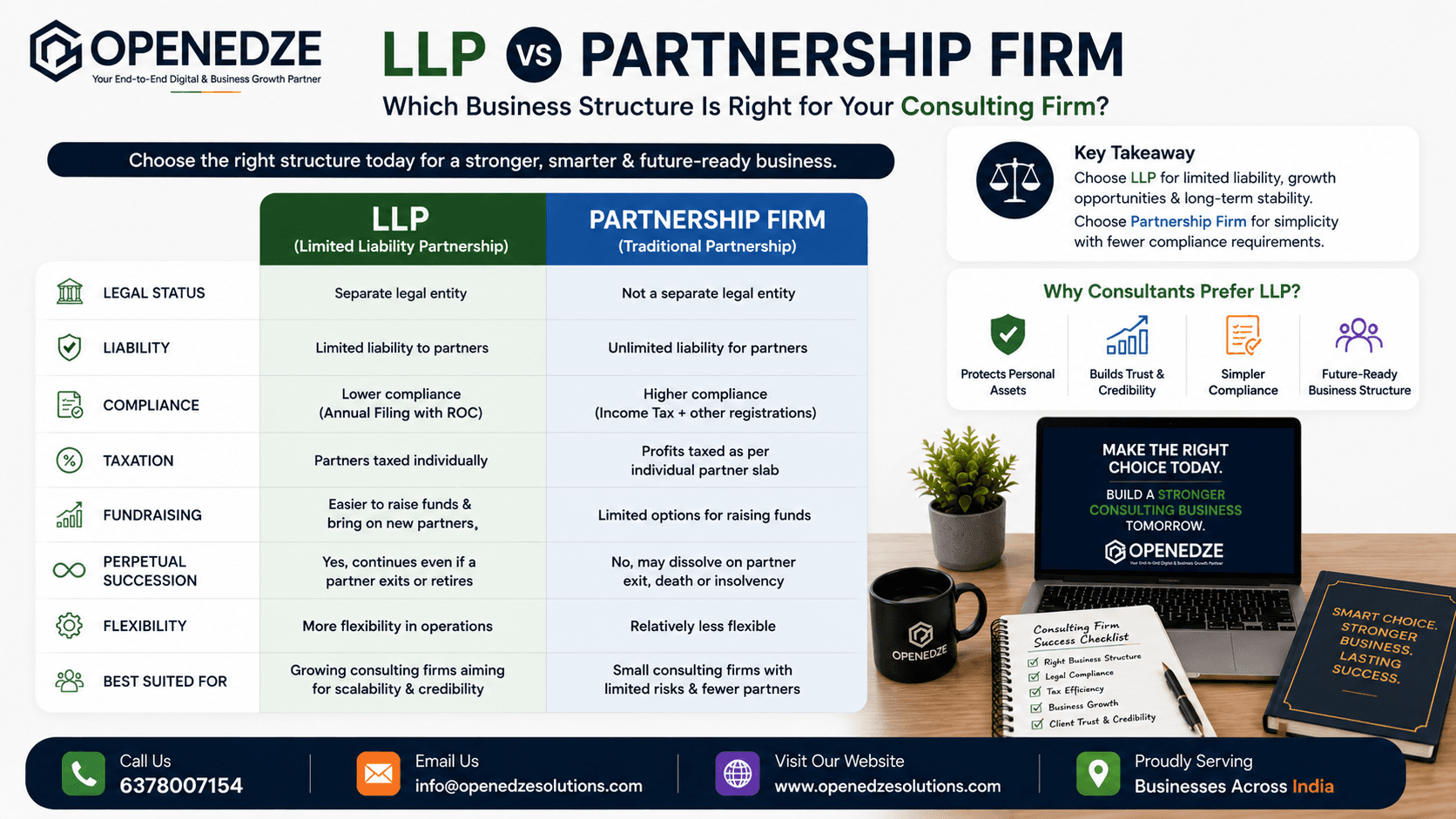
LIABILITY: Partnership = unlimited; LLP = limited
REGISTRATION: Partnership = optional (with ROC); LLP = mandatory (with MCA)
COMPLIANCE: Partnership = minimal; LLP = moderate
INVESTOR APPEAL: Partnership = low; LLP = moderate
TAXATION: Partnership = pass-through; LLP = corporate tax
PERMANENCE: Partnership = dissolves when partner exits; LLP = perpetual
FORMALITY: Partnership = informal; LLP = formal registration required

Liability Protection: The Critical Difference

Liability protection is the main reason professionals choose LLP over Partnership.

This difference can be life-changing if something goes wrong.

PARTNERSHIP LIABILITY: If the firm faces legal action or debt, all partners' personal assets are at risk. A creditor can claim your personal bank account, home, etc.
LLP LIABILITY: A partner's personal assets are protected. Only the firm's assets are at risk.
PARTNERSHIP RISK: If a partner acts negligently, other partners can be held personally liable
LLP RISK: Limited to the partner's capital contribution and profits
PROFESSIONAL LIABILITY: In professions like law, LLP provides better protection against malpractice claims
Strategic note: Real Risk: In a law practice, if one lawyer commits malpractice, all partners in a partnership firm are personally liable. In an LLP, only the responsible lawyer and the firm are liable.

Compliance & Taxation Comparison

Compliance burden and taxation are the other major differences.

These affect your operational costs and administrative burden.

PARTNERSHIP COMPLIANCE: Minimal filing, annual returns optional, no audit required (unless turnover > ₹1 Cr)
LLP COMPLIANCE: Annual MCA filings, annual statement of accounts, annual return, potential audit requirement
PARTNERSHIP TAX: Partners pay individual income tax on their share (10%-45% slabs)
LLP TAX: Entity pays corporate tax (30%) + partners pay individual tax on distribution
PARTNERSHIP: Pass-through taxation (flexibility in profit distribution)
LLP: Corporate entity with separate taxation

Can You Convert From Partnership to LLP?

Many professionals start as partnerships and later convert to LLP when they realize the benefits.

The conversion process is possible and straightforward.

Yes, you can convert partnership to LLP
Process: Dissolve partnership, register LLP, transfer assets and liabilities
Timeline: 30-45 days for complete conversion
Cost: ₹5,000-₹15,000 including professional fees
Advantages: Gain liability protection while maintaining operational flexibility
No disruption to business operations

Decision Matrix: Partnership or LLP?

Here is a practical matrix to help you decide which structure is right for your professional practice.

Use this to guide your decision.

CHOOSE PARTNERSHIP IF: You have just 2-3 partners, minimal liability risk, want minimal compliance, bootstrap budget constraints
CHOOSE LLP IF: You have multiple partners, want liability protection, professionals want formality, planning to scale, clients prefer formal structure
Partnership is better for: Small consulting duos, early-stage professional practices, friends starting together, minimalist approach
LLP is better for: Law firms, accounting firms, consulting groups, established professional practices, scale-planning firms

Decide your business structure with expert guidance

Openedze can help you choose between Partnership and LLP based on your specific situation, and handle the registration process.

Consult on Structure

FAQs

Which is better for a law practice: Partnership or LLP?

LLP is strongly recommended for law practices. It provides liability protection against malpractice claims and gives the firm a formal structure that clients prefer.

Can I have unlimited partners in both Partnership and LLP?

No. Traditional partnerships have a maximum of 20 partners. LLPs can have unlimited partners. This makes LLP better for large professional groups.

Is compliance burden high for LLP?

LLP has more compliance than partnership but less than private companies. Annual filings with MCA are required, but no quarterly board meetings. It is manageable for professional firms.

What if a partner wants to exit? How does it work?

In partnership, the firm may dissolve when a partner exits (unless partnership deed states otherwise). In LLP, the remaining partners continue. LLP is more stable for this reason.

Author

Openedze Strategy Desk

Openedze Solutions helps startups, MSMEs, and growing companies build stronger operating systems across registration, compliance, funding readiness, digital presence, and automation.


Related Articles

Continue building smarter systems

View all articles