
Registration

MSME Registration in India: Complete Guide to Udyam, Benefits & Compliance 2026

Learn MSME registration through Udyam, government benefits, tax advantages, collateral-free loans, GST benefits, and how to access ₹1 lakh crore government schemes.

Openedze Strategy Desk23 May 202610 min read
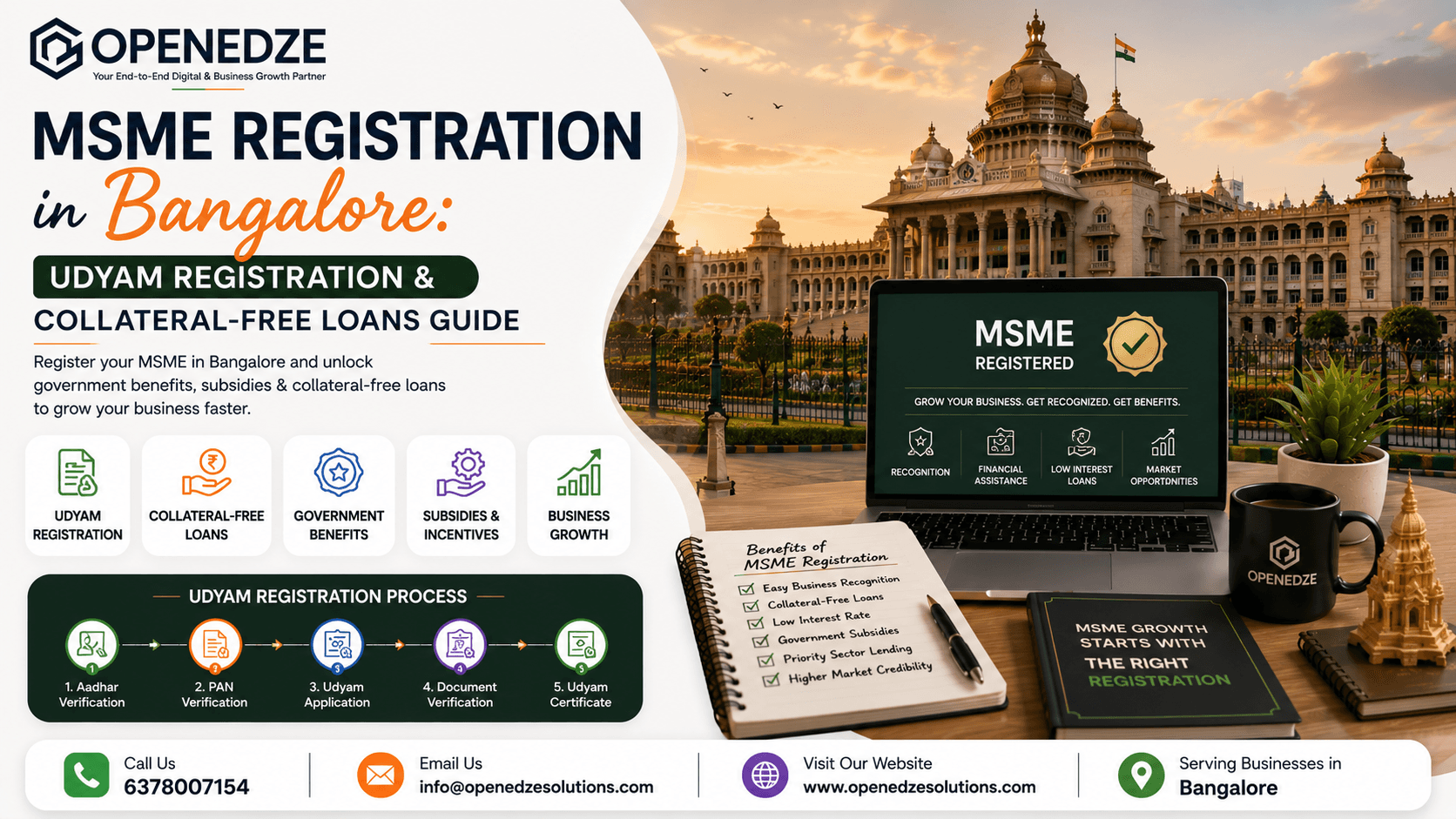
Small business owner accessing MSME government benefits and schemes
MSME government support and business growth

MSME (Micro, Small, and Medium Enterprises) registration is essential for small businesses in India. Registered MSMEs get access to government schemes worth over ₹1 lakh crore, collateral-free loans, tax benefits, and regulatory support.

The good news is that MSME registration is now completely free and online through the Udyam portal. You don't need a business registration or company incorporation to register as MSME.

In 2026, over 6 crore businesses are registered as MSMEs. If you run a small business with turnover below ₹250 crores, you should register as MSME to access these benefits.

Key Insights

MSME registration is completely free and done online through the Udyam platform (udyamregistration.gov.in).

Any business with turnover below ₹250 crores (manufacturing) or ₹100 crores (services) can register as MSME.

MSME registration gives access to ₹1 lakh crore in government schemes, loans, subsidies, and support programs.

MSME registered businesses get GST benefits, priority bank lending, and government procurement preference.

What is MSME and Why Should You Register?

MSME stands for Micro, Small, and Medium Enterprises. It is a classification for small businesses in India. When your business qualifies as MSME, you become eligible for government support, subsidies, loans, and schemes.

For small business owners, MSME registration is often more beneficial than Company registration. It is free, simpler, and comes with direct government support.

Registering as MSME is like getting a 'small business' stamp from the government. This opens access to multiple schemes and benefits specifically designed to support growing businesses.

Free online registration through Udyam platform
Immediate recognition and registration number
Access to government schemes and subsidies
Priority lending from banks
GST filing benefits
Government procurement preference
No compliance burden compared to Companies
No need for separate company registration

MSME Classification 2026: Micro, Small, and Medium

MSMEs are classified into three categories based on investment in plant and machinery (for manufacturing) or equipment (for services) and annual turnover.

As of 2026, the classification criteria were updated to encourage more businesses to register.

MICRO: Investment ≤ ₹1 crore, Turnover ≤ ₹5 crores
SMALL: Investment ≤ ₹10 crores, Turnover ≤ ₹50 crores
MEDIUM: Investment ≤ ₹20 crores, Turnover ≤ ₹250 crores
NOTE: Above limits apply to both manufacturing and service businesses
A sole proprietor, partnership, or company can be registered as MSME
The classification determines which government schemes you are eligible for
Strategic note: Classification Advantage: A Micro MSME gets more preferential treatment in government schemes. Many entrepreneurs deliberately keep their investment below the threshold to stay in the Micro category.

MSME vs Startup India: Which Should You Choose?

Many business owners are confused whether they should register as MSME or Startup India. Both are government programs, but they have different focus and benefits.

The choice depends on your business type and growth goals.

MSME: For all small businesses (traditional or innovative)
STARTUP INDIA: For innovative businesses planning rapid scaling and external funding
MSME: Free, immediate recognition, no eligibility review
STARTUP INDIA: Requires eligibility verification, takes 15-20 days
MSME: Tax benefits are limited to GST benefits and priority lending
STARTUP INDIA: 100% tax exemption for 3 years, angel investment deduction
MSME: Better for lifestyle businesses and established service providers
STARTUP INDIA: Better for tech startups seeking venture capital
YOU CAN DO BOTH: Many startups register as both MSME and Startup India to maximize benefits

How to Register on Udyam: Step-by-Step Process

Udyam is the government's online platform for MSME registration. The process is simple, free, and takes about 10 minutes.

You don't need any documentation except your Aadhaar number. That's how simple it is.

Step 1: Visit udyamregistration.gov.in
Step 2: Click 'Register as New MSME'
Step 3: Enter your Aadhaar number
Step 4: OTP verification on your registered Aadhaar mobile
Step 5: Fill in business details (name, type, location, sector)
Step 6: Enter investment in plant and machinery
Step 7: Enter annual turnover
Step 8: Provide bank account details
Step 9: Review and submit
Step 10: Udyam registration number is generated immediately
Step 11: Download and print the registration certificate
Strategic note: Instant Registration: Unlike company registration which takes 5-7 days, Udyam registration gives you a certificate immediately. You can start using your Udyam number right away.

MSME Government Benefits & Schemes Worth ₹1 Lakh Crore+

The primary reason to register as MSME is access to government schemes. The government has allocated over ₹1 lakh crore for MSME support, subsidies, and schemes.

These schemes cover loans, interest subsidies, equipment grants, marketing support, and more.

PRIME MINISTER SWANIDHI: Collateral-free loans up to ₹1 lakh for street vendors
MUDRA LOAN: Collateral-free loans up to ₹10 lakhs for microenterprises
CREDIT LINKED CAPITAL SUBSIDY: 15% capital subsidy on technology upgradation
INTEREST SUBSIDY: Up to 6% interest subsidy on bank loans
EXPORT PROMOTION: 70% subsidy on export activities
EQUIPMENT SUBSIDY: 40% subsidy on new equipment purchase
TECHNOLOGY UPGRADATION: Grants for buying new technology
MARKETING SUPPORT: Subsidies for participation in trade fairs and exhibitions

MSME Loan Schemes: Collateral-Free Financing

One of the biggest advantages of MSME registration is access to collateral-free loans. Banks are required to lend to MSMEs at preferential rates.

Here are the main loan schemes available for registered MSMEs.

PRADHAN MANTRI MUDRA YOJANA (PMMY): Loans up to ₹10 lakhs with minimal documentation
CREDIT GUARANTEE FUND TRUST: Loan guarantee scheme where government covers 80% default risk
MSME TERM LOAN SCHEME: Loans up to ₹25 lakhs at low interest rates
WORKING CAPITAL LOAN: Short-term loans for operating expenses
EQUIPMENT FINANCE: Loans specifically for equipment purchases
Average interest rate: 8-12% (vs 15-18% for non-MSME)
Processing time: 7-14 days (vs 30-45 days for non-MSME)
Documents required: Minimal (Udyam certificate, bank statements, Aadhaar)
Strategic note: Loan Advantage: An MSME can borrow ₹10 lakhs at 9% interest with minimal documentation. An unregistered business would need collateral and would be charged 15-18%.

Tax Benefits for MSME: GST and Income Tax

MSME registration provides several tax benefits that reduce your overall tax burden.

These benefits make a significant difference to your profitability.

GST BENEFIT: Composition scheme available for turnover up to ₹1.5 crores (quarterly filing instead of monthly)
GST RATE: Reduced GST rate on certain supplies for MSMEs in specific sectors
INCOME TAX: 8% income tax rate for Micro enterprises (if turnover < ₹5 crores)
PRESUMPTIVE INCOME: Can claim 8% of revenue as income (no need to maintain detailed records)
EXPORT INCENTIVE: 5% incentive for export of MSME goods
DEDUCTION: 20% deduction on profit earned from MSME income (if transferred to specific accounts)
Strategic note: Tax Saving: A Micro MSME earning ₹50 lakhs revenue can claim 8% income (₹4 lakhs) and pay only 30% tax on that. This is called presumptive income and saves you record-keeping burden.

MSME Compliance Requirements

While MSME registration is simple, there are compliance requirements you must meet to maintain your registration status.

The good news is that MSME compliance is minimal compared to company registration.

UDYAM UPDATE: Update your Udyam details if business structure or turnover changes
ANNUAL RETURN: File annual statement of accounts with Udyam (only for Micro enterprises with turnover > ₹1 crore)
GST FILING: File GST returns as per prescribed timeline
INCOME TAX: File income tax return if applicable
BANK RECONCILIATION: Maintain bank statements and reconcile with books
EMPLOYEE COMPLIANCE: Maintain ESI/PF records if you have employees
ENVIRONMENTAL COMPLIANCE: For manufacturing MSMEs, environmental clearance
Strategic note: Simple Compliance: For a Micro MSME with turnover < ₹1 crore, compliance burden is minimal. You mainly need to file GST returns on time.

Register your MSME today and access ₹1 lakh crore in schemes

Openedze can help you register as MSME on Udyam, guide you through government schemes, and help you access collateral-free loans and subsidies.

Start MSME Registration

FAQs

Is MSME registration free?

Yes. MSME registration on the Udyam platform is completely free. There are no government fees. You only need an Aadhaar number to register.

How long does MSME registration take?

MSME registration is instant. You get your Udyam registration number and certificate immediately after submission. You can start using it right away.

Can I register as MSME if I am already registered as a company?

Yes. You can register your company as MSME simultaneously. Many registered companies also register as MSME to access government schemes and collateral-free loans.

What if my turnover exceeds the MSME limit?

If your turnover exceeds the MSME limit, you are no longer classified as MSME and lose benefits. However, you can reclassify if your turnover comes back below the threshold in future years.

What is the Mudra loan amount for MSME?

Mudra loans are available up to ₹10 lakhs for MSMEs. The loans are collateral-free and interest rates are typically 8-12%. Repayment period is usually 5 years.

Author

Openedze Strategy Desk

Openedze Solutions helps startups, MSMEs, and growing companies build stronger operating systems across registration, compliance, funding readiness, digital presence, and automation.

Related Articles

Continue building smarter systems

View all articles