
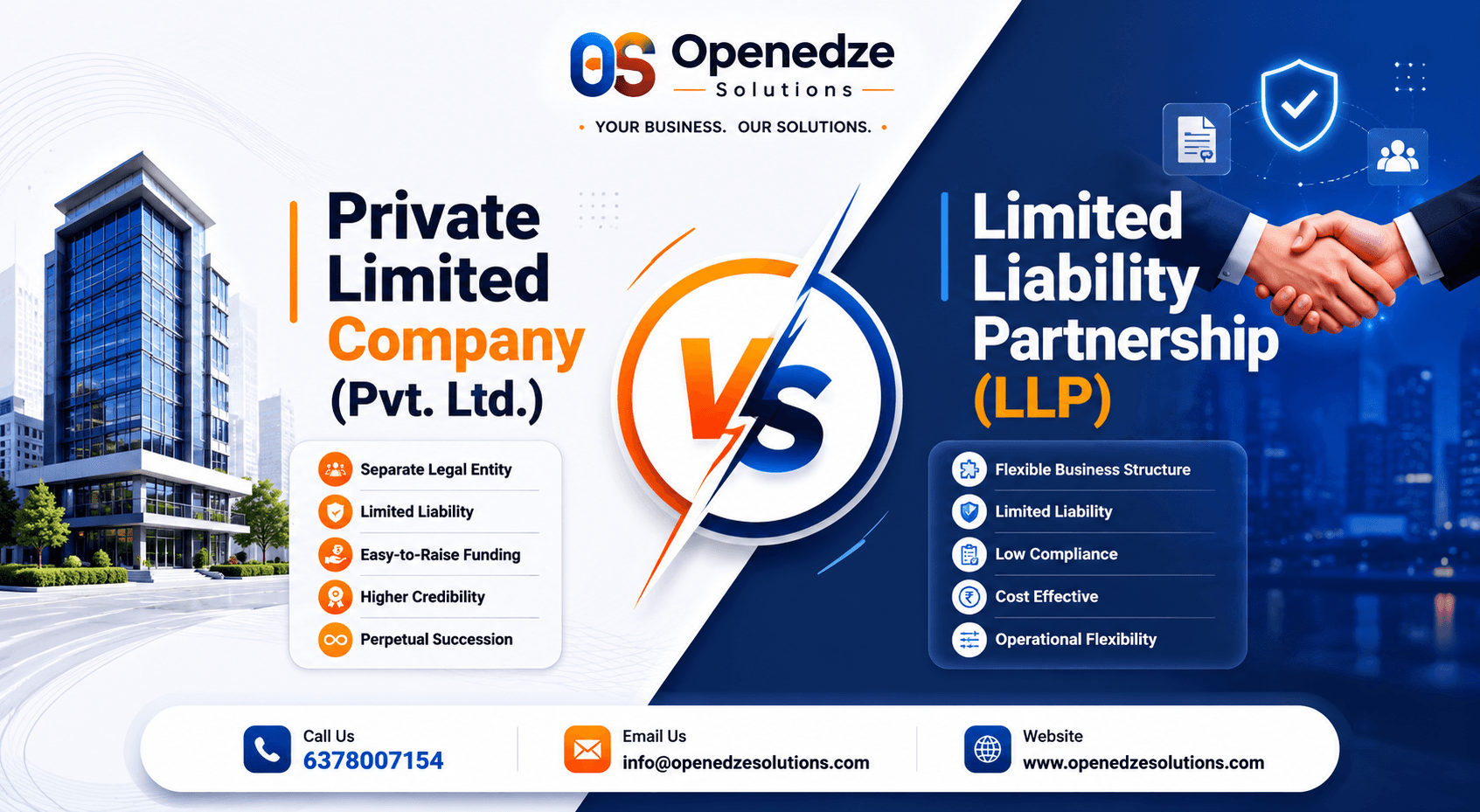
Choosing between a Private Limited Company (Pvt Ltd) and a Limited Liability Partnership (LLP) is one of the most important decisions a startup founder makes. Both are popular business structures in India, but they differ significantly in registration, compliance, taxation, and governance.
The wrong choice can result in unnecessary compliance burden, higher taxes, or inadequate legal protection. The right choice sets your business up for scalability, investor readiness, and sustainable growth.
This guide provides a side-by-side comparison to help you make an informed decision based on your business model, funding plans, and long-term vision.
Key Insights
Private Limited Companies are more suitable for venture-funded startups, scalable tech companies, and businesses planning to raise external capital.
LLPs are ideal for consulting firms, professional services, and partnerships where you want simpler governance with liability protection.
Private Limited Companies have higher compliance requirements but better investor credibility.
LLPs have lower compliance burden but limited scalability and investor appeal.
What is a Private Limited Company?
A Private Limited Company (Pvt Ltd) is a separate legal entity where ownership is divided into shares. The company's liability is separate from the shareholders' personal liability, meaning creditors cannot claim the personal assets of shareholders.
Private Limited Companies are registered under the Companies Act, 2013. They are the most common structure for ambitious startups, especially those seeking venture funding or planning significant growth.
The minimum requirement is 2 shareholders and 2 directors. The maximum is 200 members (shareholders). Shares cannot be transferred freely and cannot be offered to the public.
What is an LLP (Limited Liability Partnership)?
An LLP is a hybrid business structure that combines features of a partnership and a company. It provides the flexibility of a partnership with the liability protection of a company.
In an LLP, partners have limited liability but more autonomy in management compared to a company. LLPs are registered under the Limited Liability Partnership Act, 2008.
LLPs are particularly popular among consulting firms, law practices, architecture firms, and professional services because they offer operational simplicity with legal protection.
Key Differences Between Private Limited and LLP
While both Private Limited Companies and LLPs offer liability protection, they differ significantly in structure, governance, compliance, taxation, and scalability. Here is a detailed comparison.
Understanding these differences helps you choose the structure that aligns with your business goals and operational preferences.
Registration Process: Pvt Ltd vs LLP
Both structures are registered online through the MCA (Ministry of Corporate Affairs) portal. The process is similar, but there are some differences in documentation and timelines.
Here is the typical registration timeline and process for each.
Compliance Requirements: Which Has More Burden?
Private Limited Companies have significantly higher compliance requirements. This is the tradeoff for the credibility and investor appeal they offer.
LLPs have lighter compliance, making them attractive for businesses that want simplicity and operational freedom.
Taxation: How Are Pvt Ltd and LLP Taxed?
The taxation structure is one of the most important differences between Pvt Ltd and LLP. The choice can significantly impact your overall tax liability.
Both structures provide certain advantages depending on your revenue, profit margins, and distribution strategy.
Liability Protection: Pvt Ltd vs LLP
Both structures provide liability protection, but in slightly different ways. Understanding this protection is crucial for protecting personal assets.
In both cases, the business entity is liable for its obligations, not the owners/partners personally (except in case of fraud).
Which Should You Choose? Decision Matrix
Choosing between Pvt Ltd and LLP depends on your business model, growth plans, funding needs, and operational preferences. Here is a practical decision framework.
Ask yourself these key questions to determine which structure is right for you.
Register your startup today
Openedze Solutions helps you choose the right business structure and complete registration in 3-5 days. We handle all documentation, filing, and compliance setup.
Consult on Business StructureFAQs
Can I change from LLP to Private Limited later?
Yes. You can convert an LLP to a Private Limited Company. The process involves dissolving the LLP and registering a new Pvt Ltd company. This usually takes 30-45 days. Many startups do this when they start raising venture capital.
Which is cheaper to register: Pvt Ltd or LLP?
LLP registration is slightly cheaper (₹5,000-₹8,000) compared to Pvt Ltd (₹8,000-₹15,000). However, the ongoing compliance costs are similar. The choice should not be based on registration cost alone.
How many shareholders can a Private Limited Company have?
A Private Limited Company can have a minimum of 2 shareholders and a maximum of 200 shareholders. Each shareholder must have at least one share.
Can an LLP raise venture capital?
Venture capitalists typically prefer to invest in Private Limited Companies due to clearer ownership structures, standardized governance, and easier exit mechanisms. While LLPs can technically raise funds, it is uncommon.
What is the difference between profit distribution in Pvt Ltd vs LLP?
In a Pvt Ltd, profits are distributed as dividends (subject to dividend distribution tax). In an LLP, profits are distributed as per the partnership agreement. LLP allows more flexibility in profit sharing ratios.
Author
Openedze Strategy Desk
Openedze Solutions helps startups, MSMEs, and growing companies build stronger operating systems across registration, compliance, funding readiness, digital presence, and automation.