
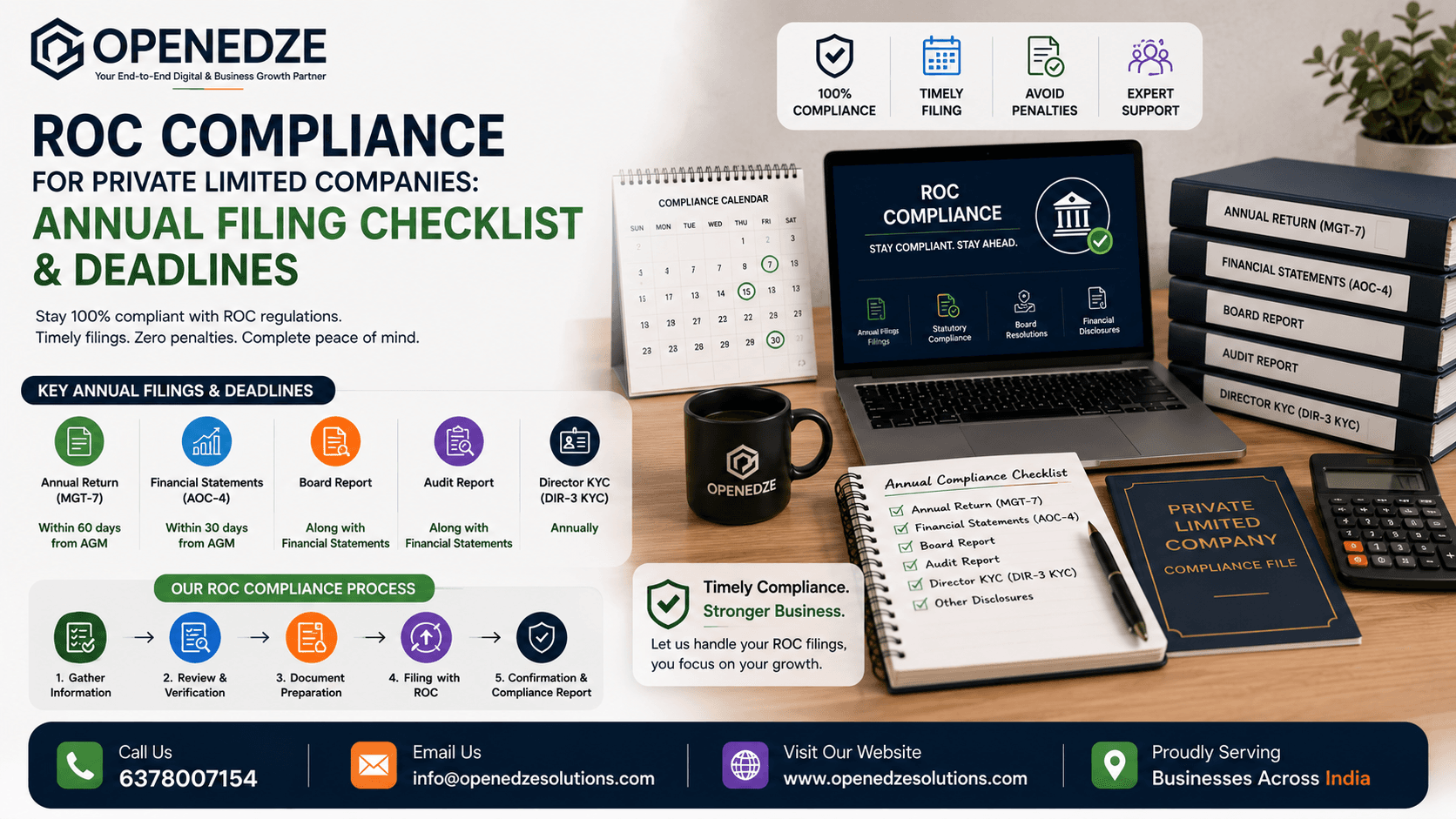
ROC (Registrar of Companies) compliance is mandatory for all private limited companies. Failure to comply can result in penalties, director disqualification, and business suspension.
Many company founders overlook ROC compliance requirements because they focus on operations. This guide explains what you need to know and do to stay compliant with ROC.
Key Insights
ROC compliance includes annual filing of financial statements, annual return, and other regulatory documents.
Deadlines are strict: missing them by even one day results in penalties.
Non-compliance can lead to director disqualification and company suspension.
Professional assistance ensures timely and accurate compliance.
What is ROC and Why Does It Matter?
ROC (Registrar of Companies) is the government body responsible for regulating companies under the Companies Act, 2013. All private limited companies must register with ROC and maintain ongoing compliance.
ROC maintains a database of all registered companies, directors, shareholders, and financial information. It also enforces compliance and investigates violations.
Annual ROC Compliance Requirements
Private limited companies must file multiple documents with ROC annually. Missing any of these results in penalties.
Here is a complete list of annual filing requirements.
ROC Compliance Documents Checklist
Before filing with ROC, ensure you have all required documents in order.
Missing documents delay filing and can result in penalties.
Critical ROC Filing Deadlines
ROC compliance deadlines are strict. Late filing results in penalties. Here are the key deadlines every company must meet.
Mark these in your calendar to avoid missing deadlines.
Penalties for ROC Non-Compliance
ROC penalties for non-compliance are significant and can escalate if violations continue.
Understanding penalties motivates timely compliance.
Step-by-Step ROC Compliance Filing Process
While the process is complex, professional guidance simplifies it. Here is the typical filing process.
Most companies hire professionals to handle ROC compliance.
Ensure your company stays ROC compliant
Openedze handles all ROC compliance filings: annual returns, financial statements, audit coordination, and AGM management. Never miss a deadline again.
Setup ROC ComplianceFAQs
What is the penalty for late annual return filing with ROC?
Late annual return filing attracts penalties of ₹1,000-₹5,000 per month of delay, capped at 3 months (maximum ₹15,000). Additionally, accumulating delays can lead to company striking off.
Can a company be struck off ROC for non-compliance?
Yes. If a company fails to comply with ROC requirements for 2 consecutive years, ROC can initiate striking off proceedings. Once struck off, the company is effectively dissolved.
What happens if a director misses ROC compliance?
Directors can be disqualified for 5 years if ROC compliance is deliberately ignored. This disqualification means you cannot be a director of any company during this period.
How often do private limited companies need to file with ROC?
Annually. Companies must file annual returns, financial statements, and audit reports within prescribed deadlines. Additionally, board meetings must be held at least 4 times per year.
Author
Openedze Strategy Desk
Openedze Solutions helps startups, MSMEs, and growing companies build stronger operating systems across registration, compliance, funding readiness, digital presence, and automation.