
Registration

Startup India Registration: Complete Guide to Benefits & Tax Sops in 2026

Learn Startup India registration, tax benefits, funding eligibility, DPIIT recognition, and how to leverage government support for your startup.

Openedze Strategy Desk22 May 202610 min read
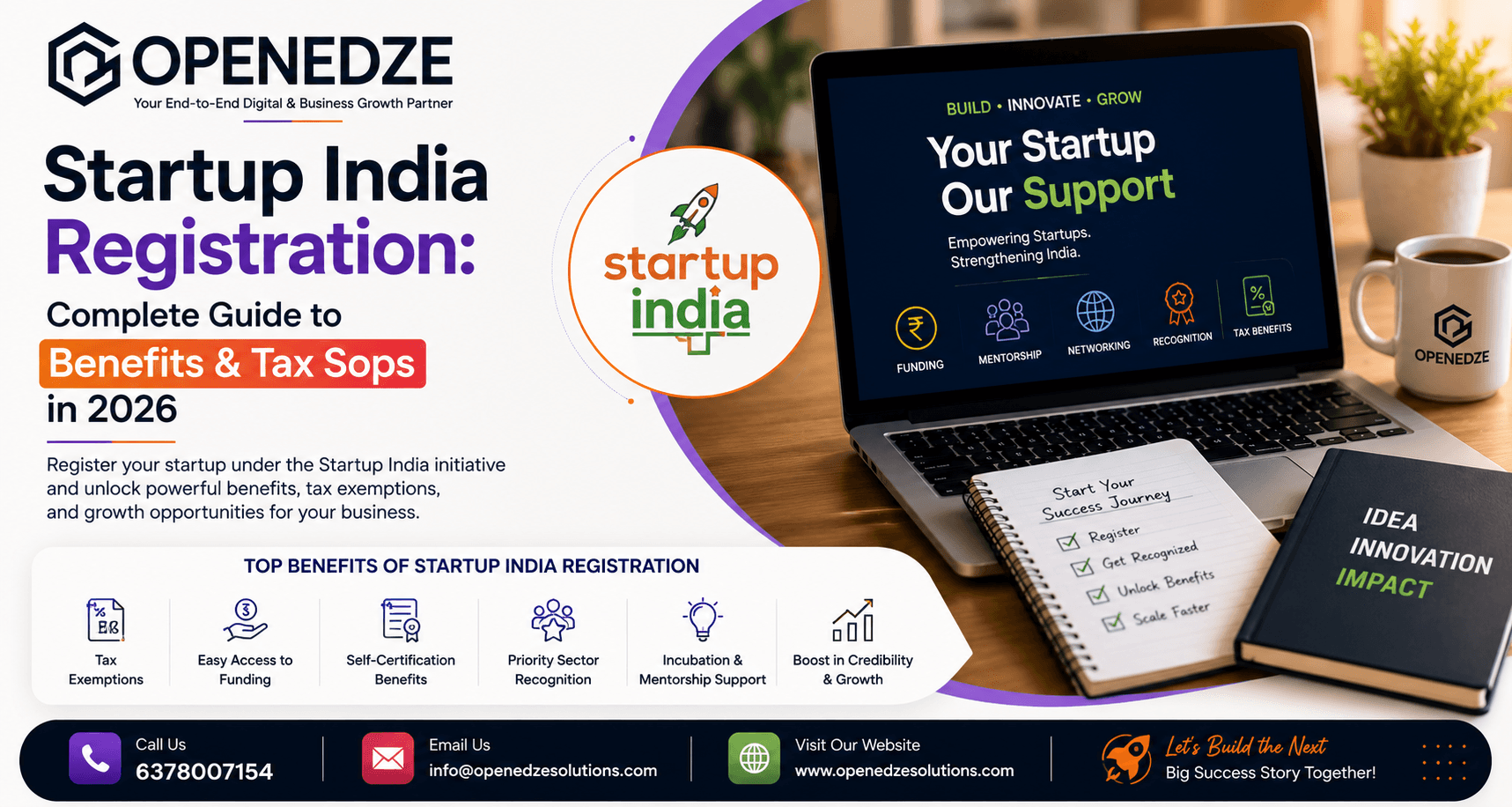
Startup founders celebrating startup India recognition and government support
Startup growth and recognition visual

Startup India is a government initiative launched by the Prime Minister to promote entrepreneurship and support startups. It provides significant tax benefits, regulatory clarity, and fund-raising support for recognized startups.

Startups that register under Startup India get access to government schemes, tax exemptions, faster IPR filing, and funding opportunities. This makes Startup India recognition a strategic advantage for most tech startups and innovative businesses.

In 2026, over 100,000 startups have registered under Startup India. Many are leveraging the tax benefits and support to scale rapidly. This guide explains everything you need to know about Startup India registration and benefits.

Key Insights

Startup India is an Indian government scheme to promote and support startups. It offers tax exemptions, funding access, and regulatory support.

You must be registered with the Department for Promotion of Industry and Internal Trade (DPIIT) to get Startup India benefits.

Recognized startups can claim 100% tax exemption for 3 years on profits, subject to conditions.

Startup India status remains valid for 10 years from the date of incorporation.

What is Startup India and Why Does It Matter?

Startup India is an initiative launched in 2015 to foster innovation and create a supportive ecosystem for startups. The primary objective is to make India a hub for startup innovation and create high-value jobs.

Through Startup India, the government provides tax benefits, regulatory ease, funding access, and fast-tracked services for recognized startups. These benefits can significantly reduce your tax burden and accelerate growth.

For a startup founder, Startup India recognition is like having a seal of approval from the government. It gives legitimacy, access to funds, and credibility with investors and partners.

Government initiative to foster startup ecosystem
Recognition through DPIIT (Department for Promotion of Industry and Internal Trade)
Tax benefits for up to 10 years from incorporation
Access to government funding and schemes
Fast-tracked patent filing and processing
Priority support from government agencies
Access to startup accelerators and incubators

Startup India Eligibility Criteria: What Qualifies?

Not every new business qualifies for Startup India. There are specific eligibility criteria based on incorporation date, business model, turnover, and innovation.

Understanding these criteria helps you determine if your business qualifies and how to structure your startup to meet the requirements.

Incorporated in India as a Private Limited Company, Partnership Firm, or LLP (within last 10 years)
Turnover not exceeding ₹100 crores in any financial year since inception
Primarily engaged in innovation, development, production, or commercialization of products/services/processes
Business is NOT just a partnership between individuals or a trading or financial/investment business
Minimum 50% of the business should be technology-driven (for tech startups)
Eligible sectors: IT, biotechnology, healthcare, renewable energy, agriculture, education, FMCG, manufacturing, automation, etc.
Can be in ANY sector except tobacco, liquor, and financial services (except fintech)
Strategic note: Clarity: Many founder-led businesses qualify for Startup India. The key test is whether the business model is innovative and not just a traditional trading or financial business.

Startup India Tax Benefits & Government Support

The tax benefits are the primary reason startups register under Startup India. Understanding these benefits helps you make the most of them.

These benefits are contingent on meeting certain conditions and maintaining compliance.

TAX EXEMPTION: 100% exemption on profits for 3 years (consecutive or non-consecutive) during the first 10 years from incorporation
ANGEL INVESTMENT BENEFIT: Angel investors claiming losses on startup investments get deduction against income
EMPLOYMENT LINKED INCENTIVE: ₹50,000 to new employees hired by startups (reimbursable to employer)
FAST-TRACK IPR FILING: Accelerated patent examination and filing (50% reduction in filing fee)
REDUCED COMPLIANCE: Ease of compliance and single-window clearance from government
SECTOR-SPECIFIC INCENTIVES: Additional benefits for biotech, green energy, and healthcare startups
Strategic note: Tax Optimization: A startup earning ₹50 lakhs profit in Year 1 can save ₹22 lakhs in taxes through the 100% exemption. This can be reinvested into growth or R&D.

How to Register for Startup India: Step-by-Step Process

Startup India registration is done through an online portal. The process is straightforward if you have the right documentation.

Here is the exact process to get Startup India recognition for your business.

Step 1: Ensure your company is registered as a Private Limited, Partnership, or LLP
Step 2: Create an account on the Startup India portal (startupindia.gov.in)
Step 3: Provide company details: incorporation certificate, PAN, CIN/LLPIN
Step 4: Submit PAN certificates of all shareholders/partners
Step 5: Upload MOA/AOA and partnership deed
Step 6: Provide detailed description of your business and innovation
Step 7: Upload letters supporting the eligibility (from recognized incubators or investors)
Step 8: Submit application and wait for DPIIT recognition
Step 9: Usually recognized within 15-20 working days
Step 10: Once recognized, you get a certificate and Startup India DPIIT registration number
Strategic note: Pro Tip: Having an investor letter or incubator letter significantly speeds up the process. Even a warm letter from an investor or mentor counts as proof of innovation.

Startup India Fund Raising & Government Support

Startup India opens doors to multiple fund-raising channels and government support mechanisms.

These include government schemes, corporate investment programs, and investor networks.

FUND OF FUNDS SCHEME: ₹10,000 crore fund to support startup venture capital funds
GOVERNMENT CONTRACTS: Priority given to startups for government procurement and bids
INVESTOR NETWORKS: Access to angel investors and venture capitalists through Startup India platform
BANK LOANS: Easier credit access through government-backed schemes like SIDBI loans
INCUBATOR SUPPORT: Subsidized mentorship, infrastructure, and networking at government incubators
CREDIT GUARANTEE: Government guarantee schemes to reduce lending risk for startups

Startup India Compliance Requirements

While Startup India provides benefits, it also comes with compliance requirements. You must maintain these conditions to retain your recognition status.

Failure to comply can result in loss of tax benefits and recognition.

CONDITION 1: Maintain book of accounts and financial records
CONDITION 2: File annual income tax returns (even if taxable income is zero)
CONDITION 3: Not to distribute 100% of profits as dividends (some profit must be retained)
CONDITION 4: Not to pay remuneration to any director exceeding ₹2.5 crore in a financial year
CONDITION 5: Principal business must remain as per the originally approved innovation
CONDITION 6: Cannot claim tax exemption if already claimed under any other scheme
CONDITION 7: Must inform DPIIT of any significant changes in business structure or ownership
Strategic note: Simple Compliance: Most of these conditions are automatically met if you operate honestly. The main thing is to file returns on time and not artificially manipulate profit distribution.

Common Misconceptions About Startup India

There are several myths about Startup India that prevent founders from registering. Let's clarify them.

Understanding the truth helps you make better decisions about Startup India registration.

MYTH 1: 'Only tech startups get Startup India benefits.' TRUTH: Any innovative business qualifies. E-commerce, healthcare, education, agriculture, and manufacturing startups all benefit.
MYTH 2: 'You need angel funding to register for Startup India.' TRUTH: Funding is not mandatory. Self-funded startups also qualify. Investor letters are optional supporting documents.
MYTH 3: 'Tax exemption is only for 3 years and cannot be extended.' TRUTH: Correct. Tax exemption is for 3 years, but you get 10 years total recognition. You can claim exemption in non-consecutive years.
MYTH 4: 'Startup India registration is complex and time-consuming.' TRUTH: The process is simple and takes 15-20 days. Openedze handles all documentation.
MYTH 5: 'Once recognized, you are exempt from all taxes.' TRUTH: Only profits are exempt, not GST, TDS, or other indirect taxes.

Get Startup India recognition today

Openedze Solutions helps you navigate Startup India registration, tax compliance, and fund-raising preparation. Leverage your DPIIT recognition for maximum growth.

Apply for Startup India

FAQs

How long does Startup India recognition take?

Startup India recognition typically takes 15-20 working days if all documents are correct. The process is faster if you have an investor letter or incubator recommendation.

Can I claim tax exemption for multiple years?

Yes. You can claim 100% tax exemption for 3 years within your 10-year Startup India validity period. These years can be consecutive or non-consecutive, giving you flexibility in tax planning.

What if my startup crosses ₹100 crore turnover?

If your turnover exceeds ₹100 crores in any financial year, you lose Startup India recognition and its benefits. This applies from the year in which the threshold is crossed.

Can a service company qualify for Startup India?

Yes. Service companies qualify if they are innovative and technology-driven. A consulting firm that just resells services would not qualify. But a service company with proprietary methodology or technology would.

Is Startup India registration free?

Yes. Startup India registration is completely free. There are no government fees. However, if you hire a consultant to manage the documentation and filing, they may charge a service fee (typically ₹2,000-₹5,000).

Author

Openedze Strategy Desk

Openedze Solutions helps startups, MSMEs, and growing companies build stronger operating systems across registration, compliance, funding readiness, digital presence, and automation.

Related Articles

Continue building smarter systems

View all articles